

Common faults and solutions of Y-seals Description
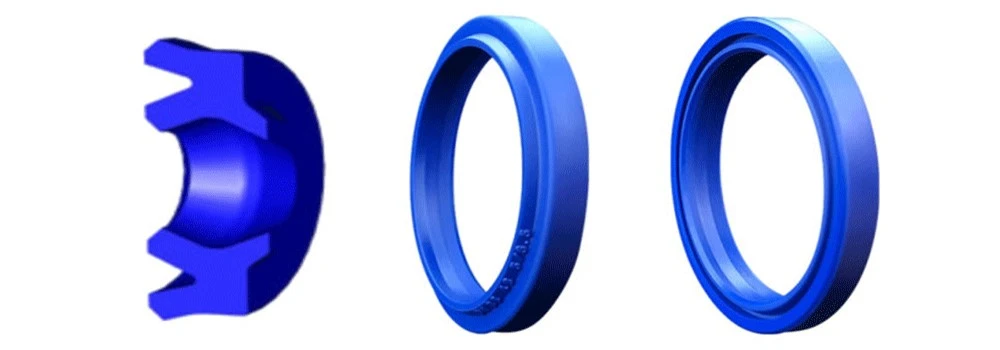
As a key component in the reciprocating sealing device, the performance of a Y-type seal directly affects the sealing effect and stability of the whole system. In practical applications, Y-seals often face the following common failures:
Interstitial bites: Interstitial bites mostly occur at the root of Y-seals, similar to O-seals. The main reasons are a seal gap that is too large, insufficient hardness of the material, and too high fluid working pressure. Interstitial bites are particularly noticeable when the working pressure exceeds 16MPa.
Backpressure Damage: When Y-seals are used as piston seals for double-acting piston cylinders, they must be used in pairs to seal high-pressure fluids in both directions. When the operating pressure is removed or reciprocating, when the pressure storage pressure is higher than the working pressure, the Y-seal will be reversely squeezed, causing the tip of the lip to be squeezed into the gap and punctured.
Flipping and twisting: When the external torque generated by the frictional force experienced by the seal is greater than its torsional resistance, it will flip or twist, thus losing the sealing ability. This is usually related to the hardness of the seal, the way it is installed, and the support structure.
Root wear: Leakage can occur when the root of the seal is severely worn, mainly due to dry friction and high friction caused by excessive interference. In addition, the roughness of the sliding surface also accelerates the wear process.
Dust damage: Impurities such as mud, dust, and sand can enter hydraulic cylinders and accelerate seal wear, leading to abnormal wear and leakage.
Resolution
Optimize the selection of sealing clearance and materials: In view of the gap bite problem, the sealing gap should be reasonably limited according to the working pressure, and the Y-type seal material with appropriate hardness should be selected. For applications where the working pressure is greater than 16MPa, it is recommended to use a special seal with a retaining ring, and the retaining ring material can be a plastic with high rigidity such as PTFE or polyamide.
Addition of pressure relief and support structure: In order to prevent damage to the back pressure, a small hole can be opened in the piston to release the pressure storage or a support ring can be added at the root of the Y-type seal. The support ring holds against the seal, preventing it from being reverse-extruded while maintaining the sealing position. In addition, the groove part can be opened with oil guide holes, so that the pressure medium acts on the recess of the seal, stretching the lips and reducing back pressure.
Increase the hardness of the material and add a support ring: In order to prevent flipping and twisting, the hardness of the material of the seal can be increased, and a support ring can be added to the mounting groove to prevent the axial movement of the seal. Support rings not only improve the stability of seals but also reduce friction and extend service life.
Optimize interference and surface roughness: In view of the root wear problem, the interference amount of the seal should be reasonably selected to avoid dry friction and wear caused by excessive or small interference. At the same time, the roughness of the sliding surface should be ensured, and Ra0.2~0.4μm is generally recommended. In addition, keeping the sealing surfaces clean and lubricated is also key to reducing wear.
Strengthen dust-proof measures: In order to prevent dust damage, a dust-proof ring should be set at the outer end of the piston rod of the hydraulic cylinder to ensure its dust-proof effect. At the same time, regularly clean and inspect the inside of the hydraulic cylinder to prevent the accumulation of impurities.


