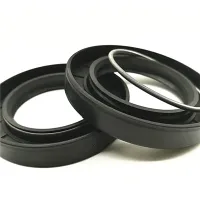


Linde Polymer Tec Co.,Ltd. is one of the most experienced manufacturers and suppliers of natural gas compressor seals in China, also supports customized service. Please feel free to buy high quality natural gas compressor seals for sale here from our factory.
Natural gas compressor seals Description
Natural gas compressor is a key piece of equipment in the natural gas transmission and storage system, and its main role is to increase the pressure of natural gas for long-distance transmission or storage. Seals play a vital role in the operation of a compressor, ensuring that gases do not leak while preventing outside contaminants from entering the system. The following is an introduction to natural gas compressor seals.
| Product material | Rubber, Graphene, PTFE, Metal |
| Hardness (Shore A) | 50 Shore A, 60 Shore A, 70 Shore A, 80 Shore A, 90 Shore A |
| Applicable temperature °C | -70°C to +250°C (-95°F to +480°F) |
| Pressure Range | -0.1 to 6.4Mpa |
| Velocity | 30 m/s(5900 ft/min) |
| Color | Black, blue, yellow, green, custom |
| Size | Standard/ Custom |
| Performance | Heat-resistant, chemical-resistant, weather-resistant, |
| Certification | ISO: 9001, ISO: 14001, IATF: 16949 |
The role of seals
The main function of the seal is to prevent natural gas leakage and the ingress of external impurities. In high-pressure environments, seals must withstand high differential pressures and temperature changes while maintaining sealing performance. The reliability of the seals has a direct impact on the efficiency and safety of the compressor.
Type of seal
Mechanical seal: A mechanical seal is a contact seal consisting of a pair of rings that rotate relative to each other and are held in contact by spring force to prevent leakage. They are suitable for both high-speed and high-pressure environments.
Dry gas seal: A dry gas seal is a non-contact seal that uses a gas film to prevent leakage and is suitable for occasions where trace leaks are not allowed.
Labyrinth seals: Labyrinth seals slow the flow of gases through a complex series of channels and gaps, and are suitable for both low and medium-pressure environments.
Soft seals: Soft seals are usually made of rubber or polytetrafluoroethylene (PTFE), which has good elasticity and flexibility, and is suitable for low-pressure and high vibration environments.

Material selection for natural gas compressor seals
The choice of material for a seal is critical to its performance. Commonly used materials include:
Rubber: It has good elasticity and flexibility, and is suitable for normal temperature, low pressure, and low corrosive environment.
Polytetrafluoroethylene (PTFE): It has excellent corrosion resistance and high-temperature resistance, and is suitable for strong corrosive media and high-temperature environments.
Graphite: It has good self-lubrication and high-temperature resistance, and is suitable for high-temperature, high-pressure, and corrosive environments.
Stainless steel: It has high strength and corrosion resistance, and is suitable for high pressure, high temperature, and corrosive environments.
Copper and aluminum: It has good thermal conductivity and corrosion resistance, and is suitable for some special working environments.
Composites combine the advantages of metallic and non-metallic materials, such as metal-graphite composite gaskets, which have both high strength and good sealing properties.
Seal design considerations
When designing seals, the following factors need to be considered:
Pressure: The seal must be able to withstand the pressure at which the compressor operates.
Temperature: The sealing material must be able to maintain performance at the operating temperature of the compressor.
Chemical compatibility: The sealing material must be compatible with natural gas and other chemicals that may be present.
Wear: Seals must be able to withstand wear and tear over long periods to maintain their sealing performance.
In summary, the seals of natural gas compressors are an important part of ensuring the safe and efficient operation of equipment. Selecting the right seal type and material, as well as proper design and maintenance, is critical to the long-term stable operation of a compressor.
Linde Polymer Tec Co., Ltd. was established in 2004, is a collection of research and development, design, manufacturing, and sales of various rubber seals in one of the enterprises, with a total investment of 20 million US dollars, covers an area of 48,000 square meters, the factory is located in the beautiful coastal city of Xiamen
The company mainly produces a variety of rubber compounds and rubber seals and currently has more than 3,000 material formulas and more than 2,000 specifications of products. Products are suitable for automotive, aviation, machinery, petrochemical, sanitary ware, medical, food, electronics, national defense, military, industrial and other fields. Since the establishment of the factory, the company has completed the process consistency operation, and the product yield rate has reached 97.1%.

Complete rubber material formulation
Formula of 2000 rubber materials
Proven custom processes
10,000 sets of seal molds, Seal Structure Design
Free seal performance and life testing
US standard, EU standard, and JP standard of various sealing performance and life testing
Stable production, adhere to zero defects
5 billion pieces a year manufacturing capacity
Hot Tags: natural gas compressor seals, China natural gas compressor seals manufacturers, suppliers, factory, Petroleum Ultrasonic Tester Seals, Compressor PTFE Oil Seal, Generator Oil Seals, Front Hub Oil Seal, J Type Oil Seals, Spring Oil Seal