

Technical parameter requirements of rubber seals in hydraulic systems
The technical parameter requirements of rubber seals in the hydraulic system mainly include the following aspects:
Sealing Performance:
Rubber seals should have extremely small leaks, even at high pressures and temperatures, and automatically adapt to changes in hydraulic oil pressure.
The sealing performance needs to improve with the increase in operating pressure and be stable over a wide range of temperatures.
Material Selection:
Rubber seals should have good compatibility with hydraulic fluids to avoid problems such as swelling, dissolving, embrittlement and softening.
The material needs to have good elasticity, wear resistance, oil resistance, and aging resistance to adapt to the complex working conditions of the hydraulic system.
Commonly used materials include hydrogenated nitrile butadiene rubber at Shore A90° and XploR® fluoroelastomers.
Mechanical Properties:
Rubber seals should have the appropriate hardness and mechanical strength to ensure that they are not deformed or damaged under high pressure and high-speed conditions.
Good compressibility and resilience, as well as a small permanent set, are required.
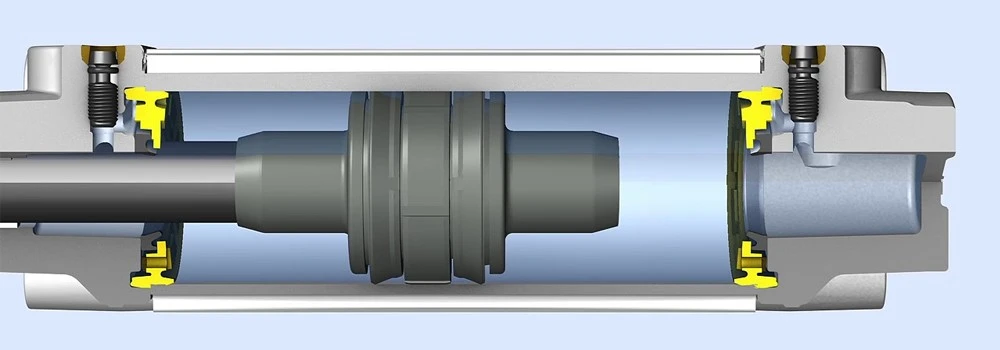
Media resistance:
Rubber seals need to be resistant to hydraulic fluids and other chemicals while maintaining stable performance at high and low temperatures.
For special applications, such as flame-retardant hydraulic fluids or environmentally friendly hydraulic fluids, the appropriate medium-resistant materials are selected.
Temperature Adaptability:
Rubber seals should maintain good elasticity and stability in the temperature range of -40°C to 100°C.
It does not soften or decompose at high temperatures and does not harden or crack at low temperatures.
Friction properties:
Rubber seals should have a low coefficient of friction to reduce wear and energy loss on moving parts.
The coefficient of friction needs to be stable to avoid fluctuations in friction properties due to temperature changes.
Dimensional Tolerances & Appearance Quality:
The dimensional tolerances of the seals should meet the requirements of the standard to ensure the accuracy of the fit with the sealing groove.
The appearance should be free of bubbles, impurities, cracks, and other defects.
Service life:
Rubber seals should have a long service life and be able to withstand long periods of high-pressure and high-speed operation.
Good fatigue and wear resistance are required.
Environmental Friendliness:
In the design and production process, environmentally friendly materials and technologies should be prioritized to reduce the impact on the environment.
Installation & Maintenance:
Seals should be easy to install and replace, and low-maintenance.
Care should be taken to clean the surface, remove burrs, and apply the appropriate amount of lubricant during installation.
In summary, the technical parameter requirements of rubber seals in the hydraulic system cover sealing performance, material selection, mechanical properties, medium resistance, temperature adaptability, friction properties, dimensional tolerance and appearance quality, service life, environmental friendliness, installation and maintenance, and other aspects. These requirements ensure the efficient operation and long-term stability of the rubber seals in the hydraulic system.


