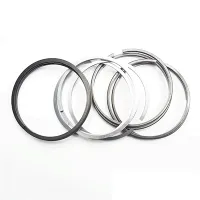


Products Description
| Material | Viton | |
|
Properties
|
Test Method
|
Values
|
|
Compound
|
-
|
100% Viton FKM
|
|
Density (Specific Gravity)
|
ASTM D297
|
2.00 g/cm2 +/- 5
|
|
Tensile Strength
|
ASTM D412
|
50 kg/cm2
|
|
Elongation at Break
|
ASTM D412
|
200%
|
|
Compression Set (25% 24hrs @ 70°C)
|
ASTM D395 Method B
|
55%
|
|
Polymer Content
|
-
|
100%
|
|
Working Temperature Range
|
-
|
-20°C to + 275°C
|
|
Heat Ageing (48hrs @ 150 °C)
|
||
|
Hardness Change
|
ASTM D573
|
+5° (Max)
|
|
Tensile Strength Change
|
ASTM D573
|
+15%
|
|
Elongation at Break Change
|
ASTM D573
|
+/- 25%
|
|
Volume Swell (24hrs @ 150 °C)
|
||
|
ASTM Oil No.1
|
ASTM D 471
|
-8%
|
|
ASTM Oil No.2
|
ASTM D 471
|
-1%
|
|
ASTM Oil No.3
|
ASTM D 471
|
+6%
|
What are Custom O-rings
Custom O-rings are used in many types of products whereas standard O-rings are used especially if a sealing problem or other issue has surfaced. Many times a product can't be designed around a standard O-ring and using a custom O-ring is the only solution. For example, valve manufacturers use custom O-rings, and sometimes they require non-standard sizes or special compounds with low-friction properties to help the valve run smoothly.
Common Material Used With Custom O-Ring
When considering a rubber material, the 5 most common are Nitrile, EPDM, Viton® (fluorocarbon), Silicone, and Neoprene® (chloroprene). There are dozens of other types of rubber materials but these 5 are the most common and will work in most applications.
- Nitrile is a great all-purpose compound that is highly resistant to oils, greases, solvents, and hydraulic fluids. It has good physical properties and a temperature range from -40°C [-40°F] to +100°C [+212°F].
- EPDM rubber is extremely resistant to ozone, weathering, water, and steam. It has a broad temperature range from -55°C [-67°F] to +125°C [+257°F] but is not compatible with petroleum oils and greases.
- Viton® (fluorocarbon) offers increased oil, solvent, chemical, and heat resistance to over 232°C [450°F]. Viton® has a higher cost and doesn't have quite the low-temperature resistance than other elastomers.
- Silicone offers a high degree of resistance to ozone, heat, UV light, general weathering, ozone, and compression set. It has the broadest temperature range from -65°C[-85°F] to +232°C[+450°F] with special compounds that are heat resistant to 315°C[+600°F]. Silicone is generally a weak material as shown by its low tensile strength and elongation properties and can tear or break easier making it undesirable for dynamic applications.
- Neoprene® (chloroprene) exhibits good abrasion, chemical, flex, heat, oil, weather, and ozone resistance. It's good in dynamic applications because of its toughness.
- Nitrile O Rings
- EPDM O Rings
- Chloroprene O Rings
- Viton O Rings
- Silicone O Rings
Along with these 5 common elastomers, many other types of elastomers may be better suited for your application such as perfluoro elastomer (FFKM), fluorosilicates, styrene-butadiene (SBR), and others.
Types of O-Rings
It is important to choose an O-ring design that will accommodate your application's specific operating environment and sealing performance requirements. The most common O-ring styles include:
Standard O-rings: Featuring a simple donut-shaped design with rounded edges, standard O-rings offer reliable leak protection in a range of basic sealing applications.
Metric O-rings: Metric O-rings are custom-molded to fit specific hardware profiles, allowing them to fill gaps that may be left by standard O-rings. They are often used in specialized high-pressure and hydraulic applications to seal pumps, valves, engine parts, flanges, and pipe joints.
Quad rings: Quad rings feature a unique four-lobed design that enables a more secure and longer-lasting seal than standard O-rings can provide. These innovative sealing solutions also offer enhanced stability in dynamic applications and improved resistance to rolling or spiral twisting. Although quad ring designs are suitable for a wide range of static and dynamic applications, they are commonly utilized in low-temperature and low-pressure environments as they can still achieve a high sealing efficiency.
Square-cut O-rings: Square-cut O-rings feature a characteristic square cross-section that enhances their working pressure and allows them to provide a secure fit under a range of operating environments. Compared with standard O-rings, their design offers superior sealing performance with better dimensional stability in high-pressure sealing applications.

Custom O-Ring Applications
O-rings can be customized to suit many sealing applications, including:
- Oil and gas. The oil & gas industry relies on high-performance O-rings that are designed to tolerate the extreme temperatures, harsh chemicals, and high pressures encountered in oil exploration, extraction, and processing applications.
- Medical. Medical devices and equipment such as syringes, pumps, and filtration systems require medical-grade O-rings that meet the industry's strict quality standards.
- Transportation. In the transportation industry, custom O-rings form reliable seals that can withstand chemicals, vibration, heat, and pressure extremes encountered in automotive and aerospace systems.
- Food and beverage. The food & beverage industry uses FDA-approved O-rings in food processing, beverage dispensing, and water filtration applications.
- Refrigeration and air conditioning. O-rings made from low-temperature-tolerant materials are used to seal ammonia and other refrigerants in air conditioners and refrigeration units.
How to Choose Custom O-Rings
Key considerations to keep in mind during the O-ring customization or selection process include:
Material selection: To provide an effective and long-lasting seal, the O-ring's material must be capable of withstanding the application's specific operating environment.
Temperature: Since the elastomers used in O-rings all have their optimal temperature ranges, it is important to select one that is compatible with the temperature requirements of your application.
Operating pressure: The amount of pressure an O-ring can tolerate will generally depend on the type of application (static or dynamic), the O-ring's durometer, and the clearance gap. Standard O-rings are engineered to tolerate operating pressures of approximately 1500 psi. For higher-pressure operations, it is indispensable to choose a higher-strength elastomer that can resist extrusion into the clearance gap.
Surface finish: An O-ring's surface finish requirements will depend on the type of fluid being sealed and the dynamics of the application.
Stretch: To fit securely within a groove, custom O-rings should be engineered to provide an optimal amount of stretch. Excessive stretch can accelerate wear and decrease sealing performance over time.
Experts in Rubber O-Rings
LINDE supplied custom o rings to many industries especially automotive, medical devices, and industrial uses industry.
For example, an automotive valve manufacturer needed a seal that would reduce the break-out (limiting) friction in their valve so it would operate correctly. We suggested a seal with a custom thickness that was not available off-the-shelf and manufactured it with a rubber compound specially formulated with low friction properties. This allowed the valve to function within the specifications it was originally designed to operate.
We've assisted in designing custom O-rings for our customer's parts that were produced out of specification. Instead of having to scrap or rework high-cost parts, we provided custom o rings that were significantly cheaper than scrapping or reworking the more expensive parts.
When you need a custom O-ring our engineers can help you design it. Our extensive knowledge of seals and elastomer compounds combined with our global sourcing expertise guarantees you the highest quality at a competitive price.
Hot Tags: custom o-rings, China custom o-rings manufacturers, suppliers, factory, Tire SBR Rubber Seal Ring, O rings Seals For Car Doors, Extra High Pressure Pump System Seals, O Rings Seals, O Rings For Endoscopes, Automotive Valve Stem Seals