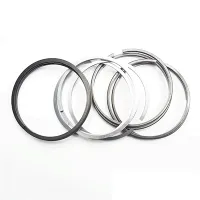


Ball Bearing Rubber Seals Description
Ball-bearing rubber seals are one of the indispensable components in industrial machinery, and their main function is to protect the bearing from the ingress of dust, moisture, and other contaminants while preventing the leakage of lubricating oil or grease. The design and material selection of these seals are critical to ensure the long-term operation and maintenance of the bearings. This article will detail the types, materials, and design principles, and how they perform in different applications.
Type of seal
Rubber seals for ball bearings are mainly divided into two main categories: contact seals and non-contact seals.
Contact seals: These seals are in direct contact with the rotating parts of the bearing, preventing the ingress of contaminants through the elastic deformation of the sealing lip. Common contact seals include single-lip seals and double-lip seals.
Non-contact seals: These seals do not come into direct contact with the rotating parts of the bearing, but rather maintain the seal through an aerodynamic effect. These seals are typically used in high-speed applications to reduce friction and heat generation.
| Product name | Ball-bearing rubber seals |
| Product material | Silicone rubber, Polyurethane, NBR, FKM |
| Hardness (Shore A) | 20 to 90 |
| Applicable temperature °C | -60 to 300 |
| Color | Black, orange, blue, yellow, green, custom |
| Size | Standard/ Custom |
| Advantage | Wear resistance, high-pressure resistance, high-temperature resistance, corrosion resistance |
| Application | Automotive, Machinery, Aerospace, Food |
| Certification | ISO: 9001, ISO: 14001, IATF: 16949 |
Material selection
The choice of material for rubber seals has a decisive influence on their performance. Common materials include:
Nitrile rubber (NBR): has good oil and abrasion resistance and is suitable for most industrial applications.
Fluoroelastomer (FKM): Excellent chemical and high-temperature resistance for extreme environments.
Silicone rubber: It has excellent resistance to high and low temperatures, and is suitable for bearings that need to operate in extreme temperatures.
Polyurethane: It has high abrasion resistance and good elasticity for high-speed or high-pressure applications.
Design principles
There are several key factors that need to be considered in the design of ball-bearing rubber seals:
The shape and angle of the sealing lip: this directly affects the sealing effect and the amount of friction.
Hardness of rubber: Hardness affects the wear resistance and elastic recovery ability of seals.
The overall structure of the seal: including whether there is a skeleton support and the installation method of the seal.

Performance
The performance of ball-bearing rubber seals varies depending on the application:
Temperature resistance: Seals of different materials can withstand different temperature ranges, and choosing the right material can ensure stable operation in high or low-temperature environments.
Chemical resistance: For chemically aggressive environments, it is critical to choose materials with good chemical resistance.
Wear resistance and durability: High-quality seals reduce maintenance and extend bearing life.
Applications
Ball-bearing rubber seals are used in a wide variety of industrial applications, including:
Automotive: Bearing protection for critical components such as engines and gearboxes.
Machinery manufacturing: plays a protective role in the bearing system of various machinery.
Aerospace: Protecting bearings from damage in extreme environments.
Food & Beverage Industry: Used in environments where cleanliness and hygiene are required.
Hot Tags: ball bearing rubber seals, China ball bearing rubber seals manufacturers, suppliers, factory, Automotive Valve Stem Seals, Electronic ACM Rubber Seals, Cable Rubber Seals, Hose SBR Rubber Seal Ring, Air Conditioner FVMQ Sealing O Rings, O Rings Seals