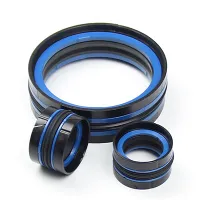
An in-depth look at Y-ring seals: the superior choice for industrial seals
In a variety of industrial applications, seals play a crucial role in ensuring the reliability and safety of machinery and equipment. As an efficient sealing component, Y-ring seals play an important role in hydraulic, pneumatic, and many other systems. This article will take an in-depth look at the design, materials, applications, benefits, and maintenance strategies of Y-ring seals.
The design principle of Y-ring seals
The design of the Y-ring seal is based on its unique Y-section that allows the ring to conform tightly to the seal face when pressurized. The lip of the sealing ring is deformed under pressure, creating a tight sealing contact, which effectively prevents the leakage of fluids or gases.

Diversity and choice of materials
The choice of material for a Y-ring seal has a direct impact on its performance and range of applications. Common materials include:
Rubber: It has good elasticity and sealing properties, and is suitable for general hydraulic and pneumatic systems.
Polyurethane: It has excellent abrasion and chemical resistance and is suitable for harsh working environments.
Polytetrafluoroethylene (PTFE): Extremely chemically stable and non-sticky, suitable for high temperatures and corrosive media.
Metals: Provides additional strength and durability in high-temperature and high-pressure environments.
Wide range of applications
Y-ring seals are used in several areas due to their excellent performance:
Hydraulic system: In hydraulic cylinders, hydraulic pumps, and hydraulic valves, Y-ring seals are used to prevent leakage of hydraulic oil and ensure that the pressure of the system is stable.
Pneumatic systems: In pneumatic tools and pneumatic control systems, Y-ring seals ensure that gases do not escape, maintaining system efficiency.
Mechanical seals: In equipment such as pumps and compressors, Y-ring seals are used as part of mechanical seals to prevent media leakage and protect the environment.
Automotive: In the braking system and power steering system of automobiles, Y-ring seals are used to maintain system pressure and ensure driving safety.
Chemical industry: In the sealing of chemical equipment, Y-ring seals can resist chemical corrosion and ensure the safety of the production process.

The importance of installation and maintenance
Proper installation of a Y-ring seal is essential to ensure its performance. The following steps should be followed when installing:
Clean the sealing surface to ensure that there is no dust or impurities.
Inspect the sealing ring for damage or deformation.
Place the sealing ring correctly in the sealing groove, making sure the lip is aligned with the sealing face.
Apply pressure evenly so that the sealing ring is fully embedded in the groove.
Regular maintenance and inspection are also key to ensuring that the Y-ring seal works effectively for a long time. This includes:
Check the wear of the sealing ring.
Inspect the sealing surface for damage.
Replace the sealing ring as needed.
A comprehensive analysis of performance benefits
The performance advantages of Y-ring seals are the basis for their wide range of applications:
High tightness: The multi-contact point design of the Y-ring seal provides a better sealing effect and effectively prevents leakage.
Long life: Uniform pressure distribution reduces wear on the sealing rings and extends service life.
Adaptable: Y-ring seals are able to adapt to different media, temperature, and pressure conditions.
Easy installation: The simplified installation process reduces the possibility of installation errors and improves installation efficiency.
Cost-effective: Compared to other types of seals, Y-ring seals offer a good balance of performance and cost.

Technological progress and innovation
With the development of industrial technology, Y-ring seals are also constantly undergoing technological innovation. The development of new materials, such as high-performance plastics and composites, has further improved the performance of Y-ring seals. At the same time, the application of computer-aided design (CAD) and computer-aided manufacturing (CAM) technology makes the manufacture of Y-ring seals more accurate and efficient.
Conclusion
Y-ring seals occupy an important position in the field of industrial seals due to their excellent sealing performance, material diversity, wide range of applications, ease of installation and maintenance, and cost-effectiveness. As technology continues to advance, Y-ring seals will continue to evolve to meet higher standards of industrial demand, providing reliable sealing solutions for a wide range of machinery and equipment.