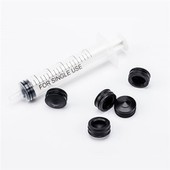
A hydraulic system is a power transmission system currently widely used in various industrial and mechanical fields. In hydraulic systems, piston seals are also indispensable rubber seals. They are responsible for maintaining the sealing of the hydraulic system and preventing liquid leakage and other impurities from entering, thereby ensuring the normal operation of the system. This article will introduce several common types of hydraulic piston seals and their characteristics.
O-ring seal
O-rings are one of the most common, simplest, and most widely used types of hydraulic piston seals. It is made of round rubber or polymer and has good sealing performance and wear resistance. The O-ring can fill the gap between the piston and the sealing groove through compression deformation so that the liquid will not leak. It is suitable for sealing requirements under medium and low pressure and temperature conditions, and the cost is relatively low.
U-shaped seal
A U-shaped seal is a rubber seal with a U-shaped cross-section, commonly used in high-pressure hydraulic systems. It is made of rubber, polyurethane, and other materials and has good sealing performance and wear resistance. The U-shaped seal uses its elasticity to fill the gap between the piston and the sealing groove to form a continuous sealing ring, which can withstand high pressure and temperature. It is suitable for sealing requirements under various working conditions and has a long service life.

V-shaped seal
The V-shaped seal, composed of rubber and other materials, has a V-shaped cross-section and is commonly employed to seal high-speed pistons. The seal exhibits excellent sealing performance and wear resistance, making it suitable for hydraulic systems with high-speed, high-pressure, and high-temperature requirements, thereby reducing friction and leakage. Its unique cross-sectional shape ensures effective sealing during piston movement.
Two-way seal
A bidirectional seal is a piston seal designed specifically for bidirectional movement, typically composed of multiple sealing elements, such as a combination of O-rings and U-shaped seals. Such seals offer dependable sealing in both directions of piston movement, preventing leakage of fluids, and the infiltration of impurities. They are ideal for hydraulic systems requiring frequent reverse movements, providing superior sealing performance.

In conclusion
Hydraulic piston seals are crucial components in hydraulic systems, with various types available for varying working conditions and demands. O-ring seals, being economical and straightforward, work best for sealing applications under medium and low pressure and temperature conditions. High-pressure hydraulic systems call for U-type seals that can withstand high pressure and temperature operation. High-speed moving pistons require V-type seals to ensure optimal performance. Effective sealing reduces leakage and friction. Two-way seals are suitable for hydraulic systems with frequent reverse movements, providing superior sealing performance. Choosing and installing the appropriate hydraulic piston seal is crucial to ensure the reliability and performance of your hydraulic system. In practical use, it is essential to choose the proper seal type based on the system's operating conditions, pressure requirements, temperature range, and other relevant factors. Moreover, regular inspection and replacement of seals are crucial to ensure the reliable and enduring functionality of the system.