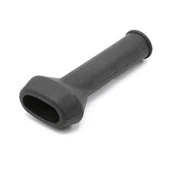
Failure analysis of compression packer rubber barrel
Packer rubber barrel is completely immersed in oil and is operated underground. The solvent molecules enter the cross-linked network of the rubber seal, causing it to swell. The system network chain density decreases, the average terminal distance increases, and the modulus decreases, as shown in the figure below. Example description;

The swelling process of cross-linked rubber seals includes two parts: on the one hand, the solvent attempts to penetrate into the rubber seal to cause its volume to swell; on the other hand, the volume expansion of the rubber seal causes the network molecular chains to extend into the three-dimensional space, causing the molecular network to expand. It produces elastic contraction under stress, trying to shrink the molecular network.
When these two opposite tendencies cancel each other out, swelling balance is reached, the elastic modulus of the packer rubber barrel decreases, and the compressive stress remains unchanged, resulting in a decrease in sealing performance. The increase in temperature accelerates the seal failure of the rubber barrel.
- Other reasons are as follows (stress relaxation, thermal oxygen aging)
- Reason 1: Stress relaxation
- Under the axial compression force of the rubber cartridge, the working surface of the rubber cartridge is completely in contact with the casing wall, and the axial compression reaches the maximum value. Under the action of external force, the polymer chain segments are forced to stretch in the direction of the external force, thus generating internal stress to compete with the external force. However, the molecular conformation is adjusted through the thermal motion of the chain segments, so that the entanglement points are dispersed, the molecular chains produce relative slippage, and gradually return to their original curled state, the internal stress is gradually eliminated, and the external force that balances it is of course also gradually attenuated to maintain The entire molecule of the constant deformation cross-linked polymer cannot produce center of mass displacement movement, so the stress can only relax to the equilibrium value, resulting in a decrease in the elastic modulus of the packer sealant barrel, resulting in seal failure.
- Reason 2: Seal failure caused by thermal oxygen aging
The most common packer seals used in oil fields are nitrile rubber seals with excellent oil resistance. The thermal oxygen aging process of nitrile rubber is shown in the figure below

Although nitrile rubber has good oil resistance, the alpha hydrogen on the nitrile rubber molecular chain reacts with oxygen at a certain temperature to form an unstable intermediate, which decomposes into two segments with a carbonyl group and a hydroxyl group. The performance of nitrile rubber changes correspondingly with the change of structure during the thermal oxygen aging process. The tensile strength and elongation strength decrease with the thermal oxygen aging process, resulting in sealing failure of the packer seal.