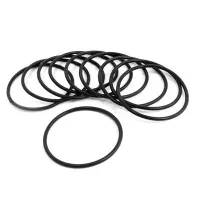
The Ultimate Guide to Rubber Seals Purchase: 5 Key Parameters Determine Product Life
In industrial equipment, automotive manufacturing, chemical pipelines, and other scenarios, the failure of rubber seals can lead to up to 40% of mechanical failures. As a global purchasing decision-maker, do you face frequent maintenance, leakage risk, or cost overruns due to insufficient seal life? This article will provide an in-depth analysis of the five core parameters that determine the life of rubber seals, and provide industry-specific selection solutions to help you optimize procurement costs by more than 30%.
Material hardness: the art of balancing sealing performance with wear resistance
Hardness (Shore A/IRHD) has a direct impact on the fit and durability of the seal. Studies have shown that:
Low hardness (40-60°): suitable for static sealing, can fill irregular surfaces (such as flange connections), but is easy to wear in dynamic scenarios
Medium and high hardness (70-90°): Automobile rotary shaft seal is standard, which can withstand more than 0.4MPa pressure, and the extrusion resistance is increased by 50%
Super-hard material (>90°): Specially designed for use in high-pressure hydraulic systems, but with a surface lubricating coating to prevent brittleness
Industry Customized Solutions:
Automotive: 60±5 IRHD is recommended for door seals to balance sound insulation and durability
Chemical pipeline: choose 75-85° corrosion-resistant fluoroelastomer to resist the erosion of acid and alkali media

Temperature resistance range: the cruel law of 50% degradation of life for every 10°C increase in temperature
The thermodynamic properties of rubber seals show significant nonlinear variations:
EPDM rubber: -50°C to 150°C for all scenarios, but the compression set rate surges by 300% above 120°C
Silicone rubber (VMQ): -60°C to 230°C ultra-wide range performance, but only 1/3 of the mechanical strength of NBR
Fluoroelastomer (FKM): Maintains <20% compression set at a high temperature of 200°C, but is easy to harden and fail below -20°C Extreme
Environment Validation Data: Arctic Circle equipment: Hydrogenated nitrile rubber (HNBR) has an elastic retention rate of >85% at -55°C
Refinery steam pipeline: Fluorosilicone rubber (FVMQ) has a service life of more than 8000 hours at 180°C/5MPa
Compression set: The invisible killer of seal failure
This parameter reflects the resilience of the material, which is required by international standards to ≤ 50%. Experiments have shown that:
Dynamic sealing scenario: 400% increased leakage risk at 3>0% deformation rate
High-temperature acceleration test: 72 hours at 125°C, the deformation rate of inferior NBR is 65%, while the modified EPDM is only 28%
Optimization Path:
1. Pre-compression design: the compression rate of O-ring cross-section diameter is controlled at 15-25%
2. Filler modification: adding graphene can improve the resilience of silicone rubber by 32%
Tensile strength: a quantitative indicator of tear resistance
The tensile strength ≥15MPa is the benchmark for industrial-grade seals. Key application scenario requirements:
Mining machinery: ≥22MPa super strong rubber, resistant to rock chip impact
Medical equipment: platinum vulcanized silicone, elongation at break > 600%
Failure warning signal:
When a crack of >0.5mm appears on the surface of the seal, the tensile property has been attenuated by 40%
Aging Resistance: A Game of Quality in the Time Dimension
Rubber aging is characterized by hardness change (ΔH) and elongation loss (ΔE). Quality seals should meet:
Outdoor exposure for 5 years: ΔH ≤ 15%, ΔE ≤ 30%
Ozone concentration 50pphm test: no cracks on the surface