

rotary shaft seal Description
Brief introduction
Rotary Shaft Seal, also known as oil seal or shaft seal, is a common mechanical sealing device that is widely used in rotary shaft systems.
Its main function is to prevent leakage of liquids or gases and to prevent external impurities from entering the mechanical equipment, thus ensuring the normal operation of the system.
This article will introduce the working principle, structure and application areas of Rotary Shaft Seal.
| Product name | Rotary shaft seal |
| Product material | Rubber/ Silicone/ Custom |
| Hardness (Shore A) | 20 to 90 |
| Applicable temperature °C | -60 to 300 |
| Color | Black, orange, blue, yellow, green, custom |
| Size | Standard/ Custom |
| Advantage | Wear resistance, high pressure resistance, high temperature resistance, corrosion resistance |
| Application | Automotive, Industrial machinery, Agricultural machinery, Aerospace field |
| Certification | IOS: 9001, ISO: 14001, IATF: 16949 |
How it works
The working principle of Rotary Shaft Seal is based on its special structure, which is usually made of elastic materials, including rubber, polyurethane or silicone rubber, among others.
The inside of the seal is in close contact with the rotating shaft, forming a sealed interface. When the rotating shaft rotates, the elasticity of the seal keeps it close to the shaft surface and encloses the liquid or gas inside the rotating shaft system by friction and pressure.
At the same time, the outside of the seal is in close contact with the stationary components (e.g. housings) to prevent external impurities from entering the system.
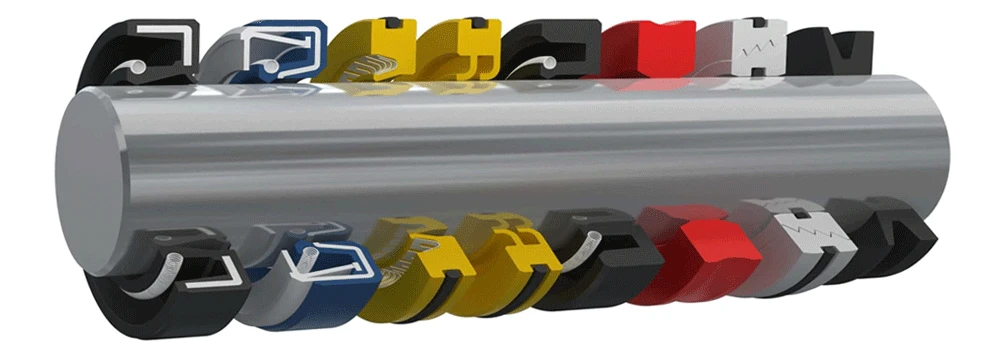
Structure
A Rotary Shaft Seal usually consists of the following parts:
Shell
The outer shell is the outer protective layer of the seal, usually made of metal or synthetic material, which has good wear and corrosion resistance.
Sealing Lip
The sealing lip is the core part of the seal, which is in contact with the rotating shaft and provides a sealing effect. Sealing lips are usually made of elastomeric material, which has good sealing and abrasion resistance.
Spring
The spring is located inside the sealing lip and provides the right amount of pressure to ensure that the sealing lip remains in contact with the axis of rotation at all times.
Auxiliary Seals
Some Rotary Shaft Seals also include secondary seals to enhance sealing and prevent leakage of lubricating oil or other fluids.


