



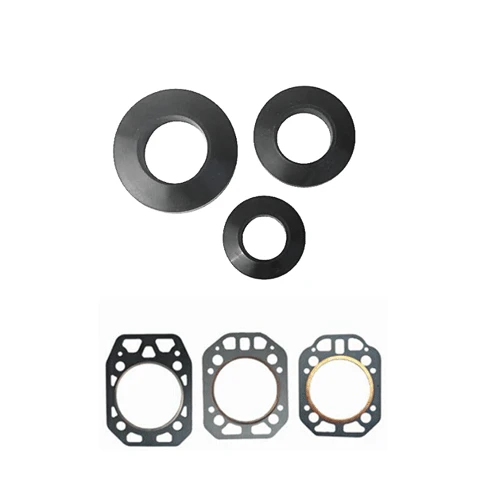
Linde Polymer Tec Co.,Ltd. is one of the most experienced manufacturers and suppliers of engine gasket in China, also supports customized service. Please feel free to buy high quality engine gasket for sale here from our factory.
Engine gaskets
Engine gaskets are sheets or gaskets used to seal between various parts of an engine. It can prevent the leakage of liquid or gas inside the antifreeze and is used to seal key locations such as between the cylinder head and the cylinder block, between the cylinder and the piston, and between the intake manifold and the cylinder block.

Inappropriate gasket material or size can cause leakage, damage, or reduced performance.
Here are some common engine gasket material options:
Metal gaskets: Common metal gasket materials include aluminum, copper, steel, and stainless steel. Metal gaskets have excellent high-temperature resistance and good thermal conductivity, and are suitable for high-temperature and high-pressure environments. They are often used for sealing between the cylinder head and cylinder block.
Paper gasket: Paper gasket is made of cellulose paper or glued paper and is frequently used in low-pressure and low-temperature environments.
Silicone gasket: Silicone gasket is made of silicone material and has splendid high-temperature resistance and chemical corrosion resistance. They are typically used in locations such as the engine's air intake system, cooling system, and exhaust system.
Polymer gaskets: Polymer gaskets include polyester, polyimide (PI), polytetrafluoroethylene (PTFE), and other materials. They have good sealing properties, chemical resistance, and low friction coefficient, making them suitable for some special applications.
Composite gaskets: Composite gaskets are typically made from a combination of layers of materials to take advantage of the performance benefits of each material. For example, metal sandwich gaskets are alternately stacked with metal layers and non-metal layers, combining the characteristics of metal gaskets and non-metal gaskets.
Certification


Silicone gaskets are made of silicone material and have the following characteristics:
- High-temperature resistance: Silicone gaskets can maintain their physical properties and sealing performance in high-temperature environments, and can usually withstand temperatures up to over 200 °C.
- Chemical corrosion resistance: Silicone gaskets have good corrosion resistance to many chemicals and can remain stable in the chemical environment of the engine.
- Elasticity and compression properties: Silicone gaskets have good elasticity and compression properties and can adapt to different surface shapes to ensure effective sealing.
- Electrical insulation properties: Silicone gaskets have excellent electrical insulation properties, which can isolate current and voltage and prevent electrical short circuits.
Silicone gaskets are commonly used in various engine sealing applications, such as sealing between the engine cylinder head and cylinder block, sealing the connection between the intake system and the exhaust system, etc.
Different engine models and specific applications may have different sealing requirements. When choosing to use silicone gaskets, it should be based on the specific scenario.
Hot Tags: engine gasket, China engine gasket manufacturers, suppliers, factory, Thick Rubber Gaskets, Camlock Gasket, Automobile Flange Seals, Pump Casing Gaskets, Automatic Transmission Oil Pan Gasket, Vacuum Cleaner Friction Disc Motor Gasket
| Silicone | ||
| Physical properties | Nominal Value (Metric) | Rated Value (Imperial) |
| proportion | 1.12 g/cc | 1.12 g/cc |
| Mechanical behavior | Nominal Value (Metric) | Rated Value (Imperial) |
| Shore Hardness (Shore A) | 50 | 50 |
| Tensile Strength (Yield) | 7.00 MPa | 1020 psi |
| Elongation (Break) | 350% | 350% |
| tear strength | 17.0 kN/m | 97.0 pli |
| permanent compression | 40% | 40% |
| @Temperature 70.0℃, Time 79200 sec | @Temperature 158 °F, Time 22.0 hour | |
| thermal performance | Nominal Value (Metric) | Rated Value (Imperial) |
| Maximum operating temperature, Air | 200℃ | 392℉ |
| Minimum operating temperature, Air | -70.0℃ | -94.0℉ |


