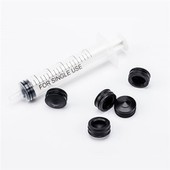
The chamfer angle, filling rate, and compression rate are crucial factors to consider while installing an O-ring as they have a direct impact on the sealing performance. Understanding the chamfer angle, compression rate, and filling rate is therefore essential. Relevant details on the filling ratio, compression ratio, and chamfer angle calculations are provided below. After reading that, I hope everyone can understand it.
Chamfer angle
In order to facilitate entry into the sealing groove and guarantee that the ring body can fill the sealing groove entirely, chamfering the sealing ring refers to beveling both ends of the sealing ring during the installation process. This improves the sealing effect and service life. Appropriate chamfering can lower the ring body's friction resistance during installation and lessen the chance of damage.
Generally, the chamfer angle is chosen according to the operating pressure and ranges from 15° to 30°. A tiny value should be approached by the angle when the pressure is high. If not, select the higher amount.
Calculation of compression ratio
The degree of compression of the seal ring caused by pressure after installation is known as the compression ratio. Usually, a percentage is used to express it.
The formula to calculate the compression ratio is W=(d0-h)/d0 ×100%.
d0--the sealing ring's free state cross-sectional diameter (mm);
h--The cross-sectional height of the sealing ring following compression, or the distance (in millimeters) between the sealing ring groove's bottom and the sealed surface.
Note: During operation, the O-ring can provide the proper sealing force if the compression rate is set correctly. While a too high compression rate will lengthen the sealing ring's service life and increase loss, an excessively low compression rate might result in leaks.
Calculation of fill rate
Definition of filling rate: After installation, the filling rate is the percentage of the contact area between the sealing ring and the sealing groove. The sealing performance improves with increasing filling rate.
Filling rate δ = sealing ring cross-sectional area/O2 sealing groove cross-sectional area (AXB) is the formula for calculating filling rate.
Note: A higher filling rate results in a greater sealing effect; nevertheless, a higher filling rate might put the sealing ring under more stress and shorten its lifespan.
There are several important things to keep in mind while thinking about seal chamfer angle, compression rate, and filling rate:
Choosing the correct O-ring size and material
Size: To guarantee that the sealing ring can fully fill the groove and create an efficient sealing effect after compression, its size must match the sealing groove.
Material: The wear, corrosion, and temperature resistance of seals made of different materials varies. It is crucial to use materials that are appropriate for the particular application setting.
The accuracy and angle of chamfering
Accuracy: During installation, the sealing ring's friction resistance and compression rate are impacted by the chamfering's accuracy. An improperly sized or shaped chamfer might lead to poor sealing or troublesome installation.
Angle: The sealing ring and sealing groove designs are typically used to establish the chamfer's angle. Maintaining a satisfactory fill rate and a seamless seal installation are facilitated by the proper angle.
Pay attention to the details during installation
Avoid damage: To prevent harming the sealing ring's surface and impairing the sealing effect, do not place hard or sharp items in direct contact with it during installation.
Lubrication and cleaning: Using the proper lubricants prior to installation can assist minimize friction while making sure that the surfaces of the seal ring and seal groove are clear of contaminants and clean.
The sealing efficacy of an O-ring installation is dependent on the chamfer's angle. Engineers can assess the seal ring's sealing ability and installation quality by computing the compression and filling ratios. A proper fit between the sealing ring and the sealing groove may effectively prevent liquid or gas leaks, therefore choose the right compression and filling rates.